


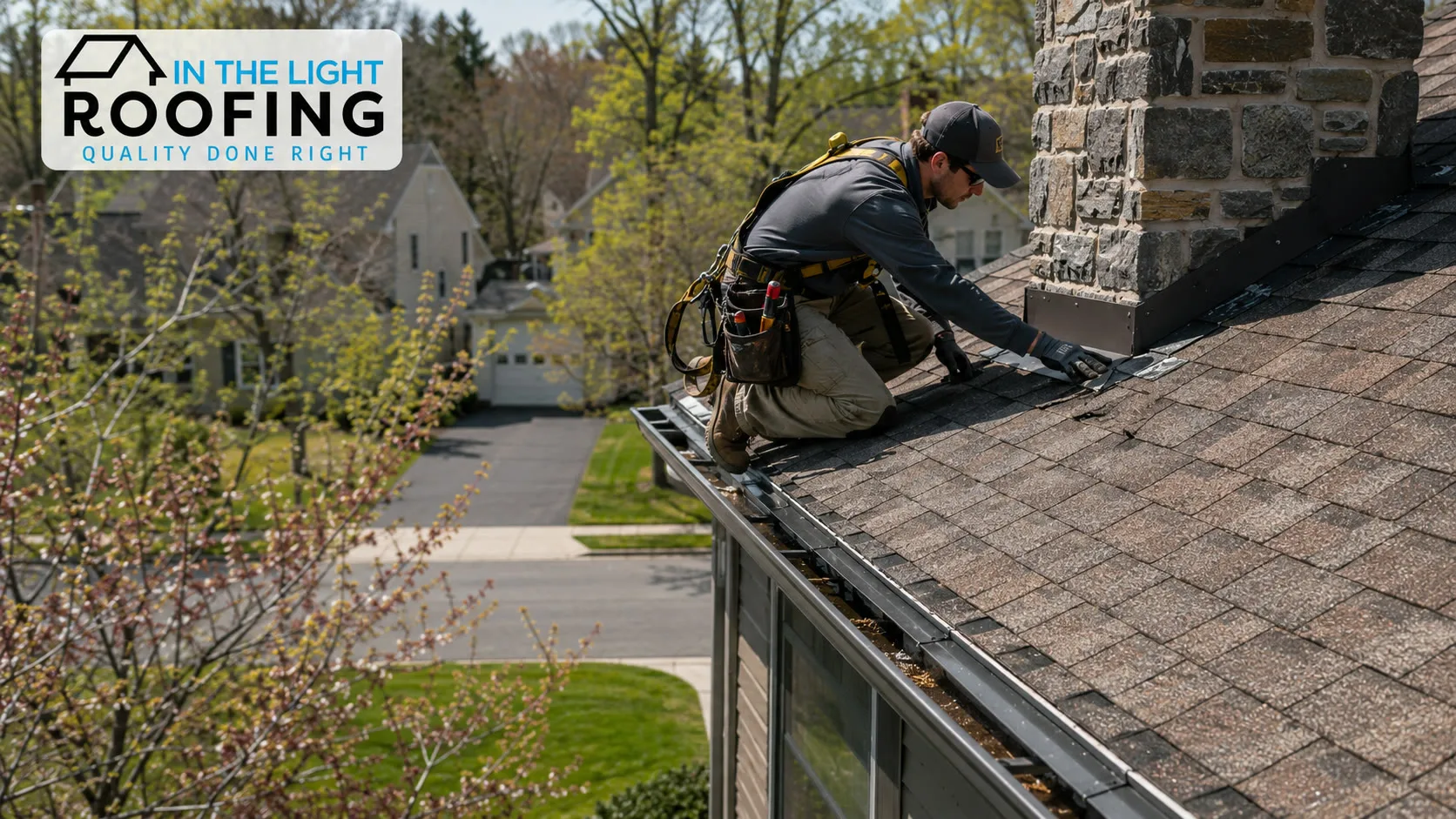
Winter in the Lehigh Valley rarely leaves a roof exactly the way it found it. Snow sits on north-facing slopes for weeks, meltwater refreezes along the eaves overnight, and wind works at the edges of shingles that were sealed tight in October. By March, when the driveway is finally clear, that evidence is invisible from the ground.
At In The Light Roofing, spring is when homeowners call about stains they first noticed in February. A spring roof inspection in the Lehigh Valley finds winter damage while it is still a repair, before the first heavy thunderstorm turns it into an interior problem.
What Winter Leaves Behind on a Lehigh Valley Roof
Our winters are defined less by one big storm than by repetition. Temperatures cross the freezing point again and again, and every cycle expands and contracts the materials overhead. Water that found a gap in December is ice by January and water again in February. So a spring inspection is not a count of missing shingles. It is a hunt for the openings a season of ice worked wider: lifted nail heads, separated flashing at a chimney or valley, cracked sealant around a vent pipe, and granules washed into the gutters.
Where Your House Sits Changes What You Look For
If your home is on one of the older streets in Catasauqua, Coplay or Northampton, it sits close to its neighbors on a narrow lot, with a steep front slope and a shallower addition at the back. Winter damage there hides at the joins: where the main roof meets the addition, in the short valley funneling half the roof into one downspout, and along the gutter line between two houses.
Up toward Slatington and Walnutport, on either side of the Lehigh River, wind is the bigger variable. Long north-facing slopes hold snow for days after the sunny side has dried, and the ridge caps and rake edges take the worst of the freeze and thaw. If part of your roof is original slate, as plenty of older houses up there still are, the spring question is the fasteners and the chimney flashing, not the slate.
Much of Whitehall filled in during the postwar years, and the ranches and split-levels built then shed water slowly by design. A low slope is unforgiving: a gap a steep roof would shrug off becomes a place where water stands until it finds a way in. Look hardest where a lower roof runs into a taller wall, and wherever a vent or bathroom fan penetrates the deck.
Newer subdivisions toward Center Valley and Macungie worry people least, and that is the trap. Complicated roof lines mean more valleys, more dormer walls and more feet of flashing, and flashing is what a freeze and thaw winter works loose.
What We Check During a Spring Roof Inspection
Our inspection has three parts, and each answers a different question.
The exterior examination
We examine the roof exterior for damaged or missing shingles, signs of wear and any visible issues. In spring that means shingles that no longer lie flat, ridge caps loosened by wind, flashing that has pulled away, and debris left by storms.
The attic and interior inspection
We inspect your attic for proper insulation and ventilation and for signs of water damage, then check interior spaces for water stains or other indicators of leaks. Homeowners skip this step most often, and it is where winter damage shows up first. A ceiling stain is a symptom. The attic tells us where the water came in.
Attic airflow is worth confirming while we are up there. Insulation shifts over a winter and soffit vents get blocked, and the attic that fed ice along your eaves in January is the one that bakes your shingles in July.
The report
You receive a detailed report of our findings and our recommendations for any repairs or maintenance the roof needs. If the roof came through winter sound, that is what the report says. If work is warranted, we follow it with a no-cost estimate so you can see the full scope first.
Signs You Should Book an Inspection Now
- Water stains on a ceiling or wall, including faint ones that stopped spreading
- Loose, cracked, curled or missing shingles visible from the ground
- A heavy layer of shingle granules in the gutters or below a downspout
- Any section of the roof line that looks like it is sagging
- Severe winter weather, including wind-driven storms, heavy rain or hail
- Fallen limbs or storm debris that landed on the roof and was never checked
What You Can Safely Check Yourself
You can do a useful first pass without leaving the ground. Walk the perimeter in good light and look up at each slope. Check the gutters and the base of each downspout for granule buildup. Look at the ceilings in upstairs rooms and along the tops of exterior walls. With safe attic access, look for daylight through the decking, damp insulation and frost marks.
What you should not do is climb onto the roof. Spring shingles are often damp, and if the decking underneath is already compromised you will not know until it gives.
Spring Storms and Insurance Documentation
Spring brings the first real thunderstorms, and wind or hail damage is rarely obvious from the ground. If your roof took a hit, we document what we find with photographs and notes you can share with your insurance provider, and we can assist with the claim. The coverage decision belongs to your insurer.
Where We Inspect
We work throughout the Lehigh Valley and the surrounding area, including Allentown, Bethlehem, Easton, Whitehall, Macungie, Catasauqua, Coplay, Northampton, Slatington, Walnutport, Center Valley and Quakertown. The inspection follows the house in front of us, not a script. You are welcome to visit us in Allentown, PA and talk through what you are seeing at home.
Booking Your Spring Roof Inspection
The whole argument for spring is timing. Damage found in April is usually a repair. The same damage found in August, after months of rain running through it, is often a much larger project, and catching it early carries a roof to its full lifespan.
Our Roof Inspections page explains what the service covers, and every project starts the same way: a call, an appointment at a time that suits you, and a written estimate before any work begins. Catch winter damage early, schedule your spring roof inspection today.
Frequently Asked Questions
When should I schedule a spring roof inspection in the Lehigh Valley?
Once the last hard freeze has passed and the roof is clear of snow and ice, usually early to mid spring, ahead of the first heavy thunderstorms.
What does a spring roof inspection cover?
A thorough exterior examination of the roof, shingles and flashing, an attic and interior inspection for insulation, ventilation and water damage, and a detailed report with our recommendations.
My ceiling stain stopped growing. Do I still need an inspection?
Yes. A stain that stops spreading usually means the water path is seasonal, not that it has closed. It tends to return with the next long rain.
Will you tell me whether I need a repair or a replacement?
That is what the report is for. We describe what we found, recommend the work the roof needs, and provide a no-cost estimate.
Do you inspect homes outside Allentown?
Yes. We serve homeowners across the Lehigh Valley and the surrounding boroughs and townships.