

Choosing a roofing material starts with the roof itself. How steep it is decides what can go on it at all. After that, it comes down to how long you want the roof to last, what you’ll pay, how the house should look and whether local rules have a say. On most pitched roofs in the Lehigh Valley the answer is asphalt shingles, the most common roof on houses here and the one we install.
Start with the slope
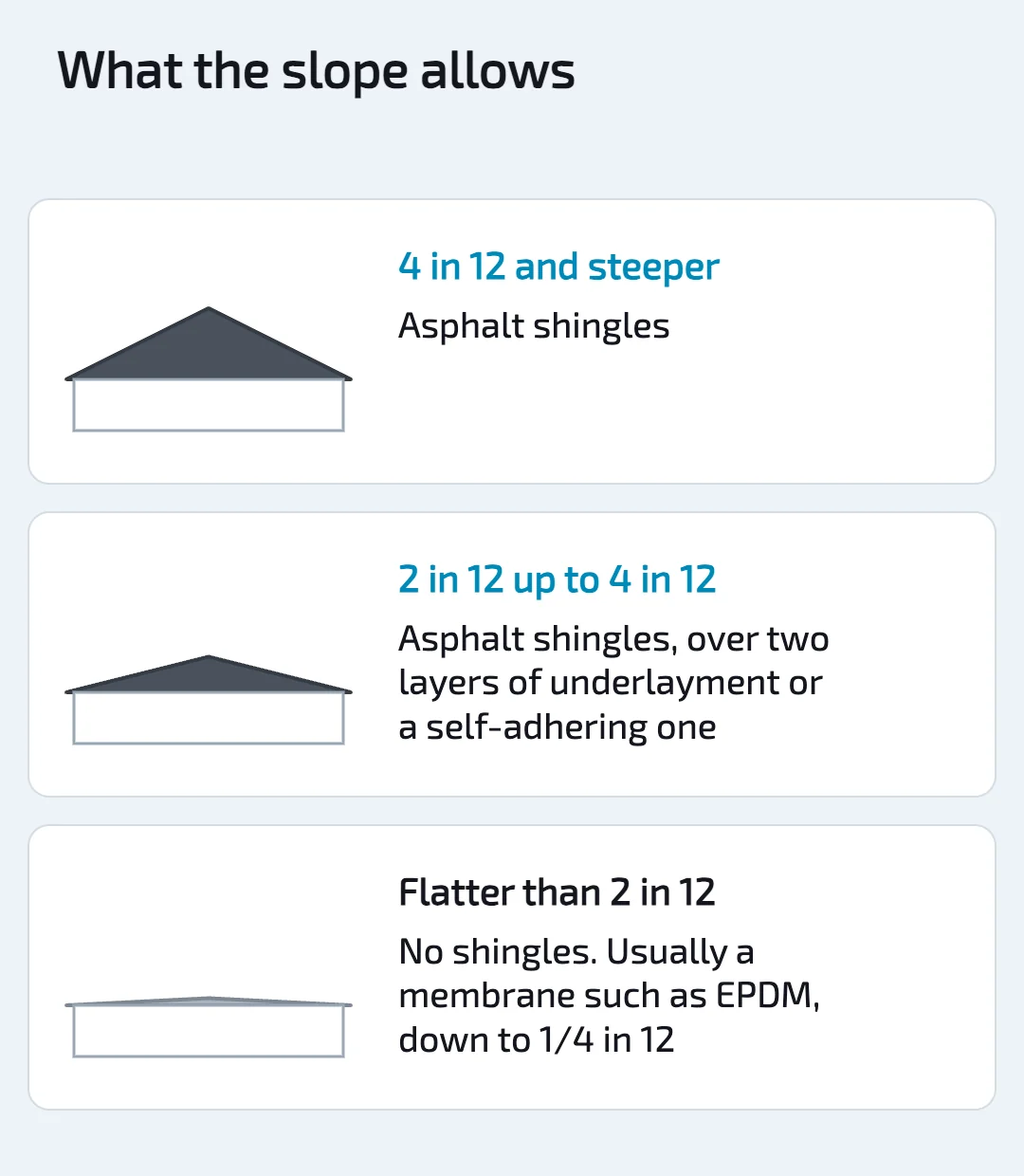
Pennsylvania’s residential code allows asphalt shingles only on roofs with a slope of 2 in 12 or steeper, which means the roof rises at least 2 inches for every 12 inches it runs. Between 2 in 12 and 4 in 12, shingles can still go on, but over a double layer of underlayment or a self-adhering one, such as ice and water shield.
Flatter than that, shingles are out. A porch roof or an addition with a roof that flat usually takes a membrane instead, such as EPDM rubber, which the code allows down to a slope of 1/4 inch in 12 so the water still drains. So if you’ve been weighing a rubber roof against shingles, the slope usually decides it for you: the membrane goes where shingles can’t, and shingles go everywhere else.
How long each one lasts
Asphalt shingles typically last 15 to 30 years in Pennsylvania, and architectural shingles outlast basic three-tab ones. Our post on how long a shingle roof lasts explains what pushes a roof toward either end of that range.
Life expectancy for metal is about 40 to 80 years, and for slate 60 to 125 years or longer, depending on the kind of slate.
Years aren’t the whole story, because the price differs too. Our guide to what a new roof costs in Pennsylvania goes through what drives it.
Snow, ice and summer heat
Whatever you choose has to cope with a Lehigh Valley winter. Where ice tends to build up along the eaves, the code calls for an ice barrier at the eaves under shingles or slate, and our post on ice and water shield shows where it goes.
Color plays a part in summer. A lighter or “cool” shingle takes in less of the sun’s heat, but it turns away some winter sun as well, and the attic’s vents and insulation matter too. Our post on asphalt shingles and energy efficiency goes through that trade-off.
How it looks, and local rules
A roof is a big part of what the house looks like from the street, so choose the material and color with the siding and trim in mind.
If you live in one of Allentown’s historic districts, roof work that can be seen from the street usually needs the city’s approval before it starts, and the city’s guidelines ask for historic roofing such as slate to be replaced in kind where possible. Our Allentown page has the details. Other towns, and some homeowners’ associations, have rules of their own, so check before you settle on something different from what’s there now.
Thinking of putting new shingles over the old ones instead? Pennsylvania allows two layers at most, and none over slate or tile.
What we install
For a pitched roof on a house, we install asphalt shingles. For flat and low-slope roofs, we install EPDM rubber membrane. If you’re planning a roof replacement, we’ll help you choose the shingle and the color.
Frequently Asked Questions
What is the best roofing material for a house in Pennsylvania?
There’s no single answer. Asphalt shingles are the most common choice on pitched roofs, metal and slate last longer, and a flat or nearly flat section usually takes a membrane such as EPDM.
Can shingles go on a flat roof?
No. The code allows asphalt shingles only on slopes of 2 in 12 or steeper, so a flat or nearly flat roof usually takes a membrane such as EPDM.
Is a rubber roof better than shingles?
They do different jobs. An EPDM rubber membrane is for flat and nearly flat roofs where shingles can’t go, and shingles are for pitched roofs.
Can a new roof go over the old one?
Sometimes. Pennsylvania allows two layers at most, and never a new layer over slate or tile. Our post on roof layers in PA explains when an overlay works and when the old roof has to come off.
Planning a new roof? Call (484) 553-0213 or request an estimate.