

You’ll see asphalt shingles on more houses in Allentown and the Lehigh Valley than any other kind of roof. If you’re planning asphalt shingle roofing for your home, three things decide how it turns out: the kind of shingle, the color, and the layers that go on underneath. Color also has a say in how hot the attic gets in July. So do the attic’s vents and insulation.
Picking the shingle
The plainest kind is the strip shingle, a long strip with cutouts along its lower edge. Three-tab, where the cutouts split each strip into three tabs, is the strip shingle you’ll see most often. Strip shingles differ in the number, shape and line of their cutouts, and that changes the texture and the shadows across the roof.
Laminated shingles, also called architectural shingles, are built up from more than one layer. The extra thickness gives the roof more visual depth. Our post on how long a shingle roof lasts in Pennsylvania compares how long each kind tends to last.
Color, and the caps along the top
Shingle makers sell many designs, textures and colors. The roof is a big part of what anyone sees from the street, so choose a color with the siding and trim in mind.
Color isn’t only about looks. Shingles surfaced with light-colored or specially made “cool” granules take in less of the sun’s heat than a conventional dark roof. There’s more on what that does for the house below.
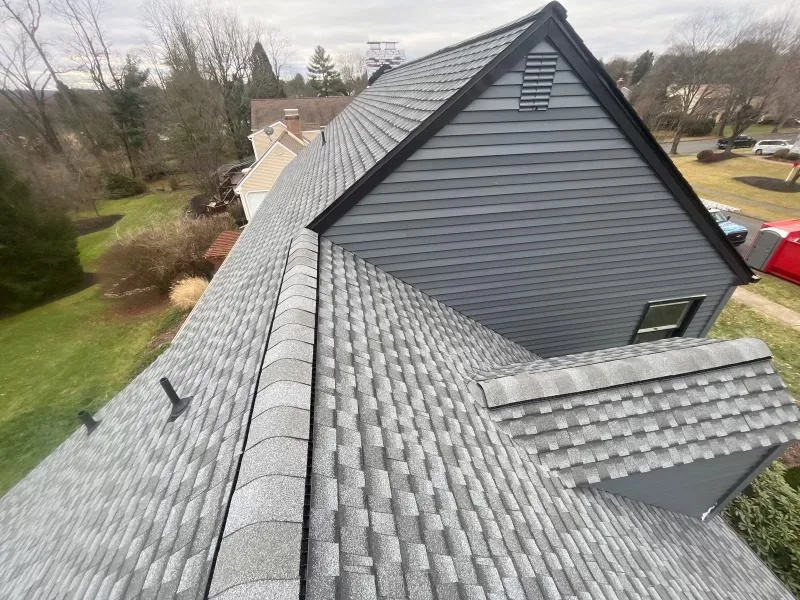
The ridge and the hips get their own cap shingles. They cover the joints at the peak and the corners, and they also draw the line of the roof against the sky, so they’re worth choosing along with everything else.
What keeps the attic cooler in summer
In July the sun bakes the roof deck, and that heat radiates down into the attic. There are two ways to take some of it out.
One is the shingle itself. A reflective shingle keeps more of the sun’s heat off the deck, so less of it reaches the rooms below. Shingles made with special reflective pigments tend to cost more than ordinary ones.
Our winters cut the other way. A roof that turns away summer sun also turns away some of the winter sun, so in cold climates a cool roof may raise heating use, though summer savings typically make up for it. The sun sits lower in winter and the days are shorter, which shrinks the effect, and snow that stays on the roof shrinks it further.
The second is the attic. Good ventilation can reduce the energy used to cool the house and make it more comfortable, and our late-summer roof guide explains how an attic is vented and what blocks it. Insulation, and sealing the gaps where air leaks up from the house, help a cool roof save as much as it can.
One thing you won’t find on shingles any more is an ENERGY STAR label. The program for roofing products ended in 2022.
The layers under the shingles
An asphalt shingle roof is a set of layers, and a good estimate says what goes into each one. From the wood up:
- The deck, the plywood or boards everything is nailed to. Soft or rotted sections may not show until tear-off, and how they’re dealt with is in our roof decking post.
- Underlayment laid over the deck, with a self-adhering ice and water shield at the eaves, in the valleys and around chimneys and skylights, where water is most likely to find a way in.
- A starter strip along the eaves and the gable edges, which is where wind damage tends to start.
- Flashing wherever the roof meets something else, such as a wall, a chimney or a plumbing vent pipe. The signs of failing flashing are in our post on roof flashing repair.
- The shingles, laid from the bottom edge up, with each row overlapping the one below so water runs off.
- Cap shingles over the hips and the ridge.
Whether the old roof is stripped first is its own question, answered in our post on how many roof layers Pennsylvania allows. For what else the paperwork should cover, see what a roofing estimate should include.
When you’re choosing a shingle and a color, ask us for an estimate. It’s free. Call (484) 553-0213 or send a note from our contact page.