

Not necessarily. Once the old shingles are off, the roofer checks the deck and replaces only the sheets or boards that are rotted, delaminated, broken or unable to hold a nail. You need to replace roof decking across the whole roof only when the damage is widespread, the deck does not suit the shingle going on, or the surface is too uneven to build on. Because nobody can see the whole deck until tear-off day, a good contract settles in advance how extra decking is handled and priced.
Roof decking, also called sheathing, is the plywood, oriented strand board (OSB) or boards your shingles are nailed to. If you are planning a roof replacement, the sections below cover how the deck is checked, what bad decking looks like, what can widen the job and what your contract should say.
What does roof decking do under your shingles?
The deck is the base the whole roof is fastened to. It spans the rafters or trusses, and every shingle nail has to bite into it and hold. On a newly built house the deck goes on new with the framing, so this question belongs to replacements rather than new roof installation.
Shingle makers are specific about the deck. IKO's application instructions say it must be smooth, firm, clean, dry and securely nailed, with exterior-grade panels that meet the building code. Owens Corning asks for a properly built and supported deck with adequate nail-holding capacity and a smooth surface.
Both makers also say where their responsibility ends. IKO takes none for leaks or defects caused by a badly prepared surface, and Owens Corning takes none for problems caused by departing from its instructions. So the state of the deck can affect your shingle warranty as well as the roof.
Plywood and OSB are the usual sheet materials. APA, the engineered wood association, calls them the most popular roof sheathing materials in the U.S.
Can a roofer see the decking before the old roof comes off?
Only part of it. Shingles and underlayment hide the top of the deck, and the attic shows only the underside. Wood can look sound from below and still be soft on top, especially under an old leak at a chimney, a vent or a leaking roof valley.
An overlay, where new shingles go over the old ones, hides the deck completely. That is one reason our post on how many layers of roofing are allowed in PA favors a full tear-off.
Some clues do show before any work starts:
- A roof line that dips or sags between the rafters, which can point to structural problems underneath.
- Shingles that ripple or show a pattern of ridges. APA notes that improperly installed roof sheathing can make asphalt shingles warp or buckle.
- Dark stains, damp or crumbling wood, peeling plywood layers or daylight on the attic side of the deck.
- Mold or mildew on the underside of the sheathing.
None of these tells you exactly how many sheets are bad. So a careful estimate describes what the deck might need rather than promising a number.
What does rotted or damaged roof decking look like?
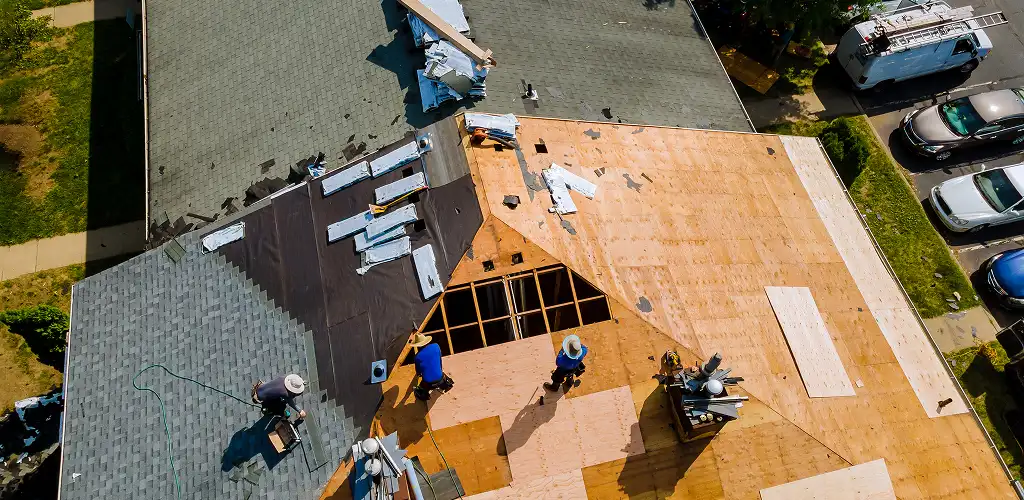
On tear-off day, bad decking is not subtle. It feels soft or spongy underfoot, crumbles at the edges, shows layers coming apart or will not hold a nail. Boards may be split or broken. If the plywood under your shingles has rotted, it has to come out. Shingle makers require a firm, dry, securely nailed deck, so rotted wood cannot be shingled over.
Not every mark means rot, though. APA's guidance on panels soaked during construction says wood construction will normally be structurally sound after severe exposure to moisture. A stain from an old leak that has since dried can leave a sheet firm and usable.
Mold works the same way. APA says mold and mildew do not cause significant loss of strength, but prolonged high moisture can support wood decay fungi, which can cause serious structural damage. So the test for each sheet is whether it is still firm and flat and holds a nail.
How is roof decking checked and replaced during a tear-off?
Once the old shingles and underlayment are off, the whole deck should be checked, not only the spots that leaked. The crew feels for soft areas and looks for rot, delamination, split boards and loose or missing nails. Raised edges matter too, since they would show through the new shingles.
Bad sections are cut out back to sound wood, and new sheets go in, fastened to the rafters or trusses. APA's builder tips for roof sheathing call for a level nailing surface, proper fastening and a small gap between panels so they can expand. Then the deck needs to stay dry. APA advises laying underlayment over dry sheathing, and Owens Corning tells installers to keep the deck from getting wet before, during and after installation.
For the rest of tear-off day, from setup to cleanup, see our post on what to expect during a full roof replacement.
When does a re-roof need all new sheathing?
Replacing a few bad sheets around a chimney or under an old leak is a contained job. Roof sheathing replacement across the whole roof usually comes down to one of three things.
The first is widespread damage. Rot or delamination over large areas points to a long-running moisture problem, such as poor attic ventilation or condensation. APA's moisture guidance notes that good roof ventilation helps sheathing dry out after minor leaks or condensation. Fix that cause along with the wood, or the new sheathing will face the same conditions.
The second is a deck that does not suit the shingle. Manufacturers set minimums for panel thickness and spacing, and they do not agree about board decks. Owens Corning's instructions accept deck boards. IKO's say shingles on board decks are not recommended because they can buckle, and its warranty does not cover that buckling.
Take an older house in Easton that still has its original roof, where the attic shows planks rather than sheets. Whether those boards can stay may depend on the shingle you choose, so ask to see what its instructions say about board decks.
The third is a surface too uneven to build on. A deck patched many times, or one that waves between rafters, will show through new shingles. If the sag comes from the framing rather than the sheathing, new decking alone will not fix it, so ask whether the rafters were checked too.
If the re-roof follows a storm, the shingle damage is probably what started the conversation. Our posts on hail damage on asphalt shingles and signs of wind damage on a roof cover what to look for. The deck is checked the same way after a storm as at any other time. Whether an insurance claim pays for any decking depends on your policy and the adjuster, so ask your insurer rather than assuming.
What should a roofing contract say about decking?
Since the deck is an unknown until tear-off, the contract is where you settle it in advance. The National Roofing Contractors Association tells homeowners to insist on a written proposal with complete descriptions of the work and specifications, start and completion dates, and payment procedures. On decking, a complete proposal answers these questions:
- Is any deck replacement included in the price, and how much?
- What does each extra sheet or board cost if more bad wood turns up? A stated unit price is clearer than an open-ended line.
- What goes in as a replacement, and does it meet the shingle maker's requirements?
- How will you hear about extra decking before the work goes ahead, and will you see photos or the wood itself?
- How will roof decking replacement show on the final invoice?
NRCA also advises reading the warranty and understanding what would void it.
Where does decking fit in In The Light Roofing's replacement process?
Our roof replacement process runs from an initial call to an appointment, then the estimate, then pre-production and the deposit, and finally production day. The decking question belongs at the estimate stage, so raise it there, along with the contract questions above. There is no charge for the estimate.
If you want the underside of your deck looked at before then, a roof inspection includes the attic.
What can you check before you sign a roofing contract?
Go up into the attic on a dry day with a good light. Look at the underside of the roof, especially around chimneys, valleys, vents and the lower edges, and photograph anything stained, dark or soft-looking.
Show those photos to every roofer you are comparing, and put the same decking questions to each. And if water is coming in now, get the leak repaired first, whatever you decide about the roof.