


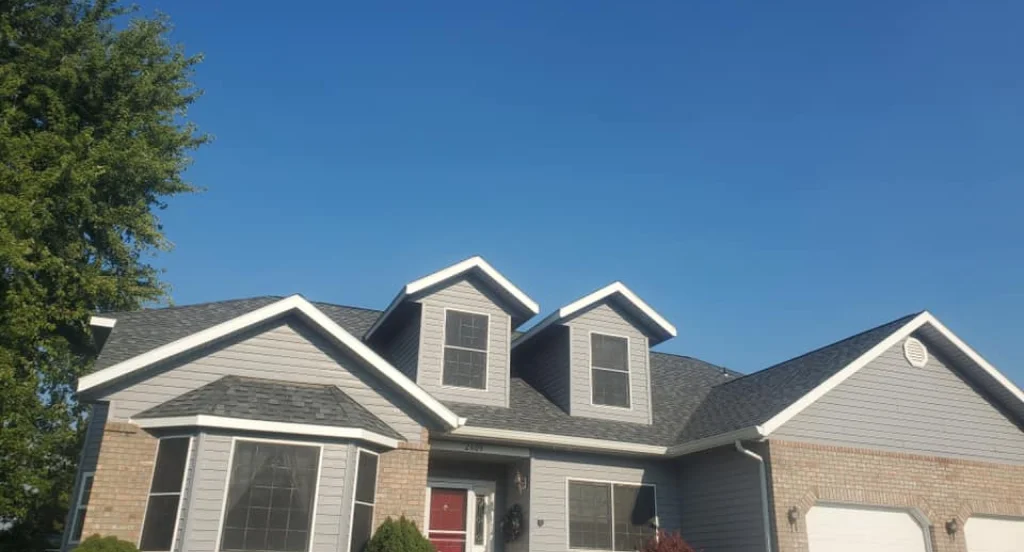
A roof valley is the channel where two roof slopes meet, and because it carries the water from both, its shingles usually wear out faster than the rest of the roof. Most valley leaks come from worn shingles, nails set too close to the center, debris or ice holding water in the channel, or a weak lining underneath. Roof valley leak repair means opening the valley, replacing any wet wood, laying a new waterproof lining and rebuilding the valley to the shingle maker's instructions. Sealant smeared over the top is a stopgap, not a repair.
This guide explains what makes valleys fail and how to tell whether one is behind the stain on your ceiling. It also compares open and closed valleys and walks through a proper repair.
What is a roof valley, and why does it wear out first?
A valley is the inside corner where two sloping sections of roof meet, including where a dormer breaks through the main roof. The National Roofing Contractors Association (NRCA) calls valleys one of the critical detail points on a pitched roof in its article on valley construction.
Valleys work harder than the slopes around them. Two slopes drain into one channel. That channel runs at a lower pitch than the roof planes feeding it, so the water moves more slowly. Leaves, needles, snow and ice collect there too. The shingle maker IKO names these same causes in a technical bulletin on valleys, and says valley shingles typically weather faster than the rest of the roof.
Say you own a Cape Cod in Whitehall with two gable dormers on the front. Each dormer adds a valley on either side, so that face of the roof has four short valleys and eight valley ends. NRCA singles out those top and bottom ends as the key points of any valley detail.
Why is my roof valley leaking?
Usually it is one or more of these:
- Worn shingles. The extra water erodes valley shingles until they crack or lose their protective surface.
- Nails too close to the center. Every nail in the water's path is a potential leak, so shingle makers tell installers to keep fasteners well back from the center line.
- A weak lining, or none at all. Linings range from plain felt to self-adhering membrane, and NRCA recommends a full-width polymer-modified sheet.
- Debris and ice. Leaves build small dams in the channel. In a Lehigh Valley winter, snow can sit in a valley, melt by day and refreeze at night, and the water it holds can work under the shingle edges.
- Square corners where shingles are cut along the valley. On closed-cut and open valleys alike, the cut shingles should have their top corners clipped and set in roofing cement. IKO's instructions say the clipped corner directs water into the valley.
- A woven valley. NRCA does not recommend weaving, because woven valleys catch debris, snow and ice, and the shingles can bridge the channel instead of lying tight.
- Valley metal that has rusted through, split at a seam or been nailed through the middle.
A related problem sits above some valleys: a downspout from an upper roof that empties onto a lower one. IKO warns that shingles under that stream can deteriorate rapidly, and a valley in its path takes the hit.
How can you tell the valley is the source of the leak?
From inside the house alone, often you cannot. Water can run along a rafter before it drips. A stain near the line of a valley is a strong hint, though, and a few checks can firm it up without anyone going on the roof.
After a rain, follow the underside of the valley in the attic with a flashlight. Dark wood, damp insulation or rusty nail tips along that line point to the valley. From the ground, binoculars will show debris in the channel, worn or cracked shingles and lifted cut edges.
A drift of granules in the gutter below suggests the valley shingles are wearing out. And a leak that appears only in downpours, or during a thaw, fits a valley that is overloaded or iced up.
If the stain sits beside a chimney, a skylight or a vent, flashing is the likelier cause, and our guide to roof flashing repair covers those spots. When the evidence is mixed, a roof inspection that includes the attic can usually pin it down. Leave the roof itself to a roofer, especially when it is wet or icy.
What is the difference between an open and a closed valley?
In an open valley, the shingles stop short of the center and a strip of metal carries the water. In a closed valley, the shingles cover the channel themselves, either cut in a line near the center or woven together. NRCA says the choice depends on the shingle, the roof slope, the climate and the look you want.
| Valley type | What you see | Where it fits | What to watch for |
| Open metal | Metal down the center, shingles trimmed back on both sides | NRCA recommends it for high-profile architectural shingles and low-slope valleys; IKO recommends it with all its shingles | Rust, split seams, shingle ends not clipped and sealed |
| Closed-cut | Shingles from one slope run through; the other side is cut in a line near the center | An accepted method in shingle makers' instructions | Nails near the center, square corners, lifted cut edges |
| Woven | Shingles from both slopes laced together | Three-tab and low-profile shingles on steeper valleys, though NRCA does not recommend it | Debris and ice in the weave, shingles bridging the channel |
IKO goes further. Its valley bulletin says it does not warrant the shingles in the valley area of a closed or woven valley. If your valley is being rebuilt, ask which method your roofer plans and why.
How is a leaking roof valley repaired?
A lasting repair rebuilds the valley from the deck up, generally in this order.
- Confirm where the water gets in, and whether a wall or chimney flashing is involved too.
- Strip the shingles or metal along the valley, far enough on each side to reach sound material.
- Replace any decking under the valley that is wet, soft or coming apart.
- Lay a new lining. NRCA recommends a full-width self-adhering or polymer-modified sheet centered in the valley, the same family of material as ice and water shield.
- Rebuild the valley. An open valley gets new metal over the lining, with the shingles trimmed back along chalk lines. A closed-cut valley gets shingles run through from one side and cut near the center on the other, with the top corners clipped and set in cement. Either way, the nails stay well back from the center.
- Blend the new shingles into the courses on both sides, and check the attic after the next heavy rain.
Owens Corning's installation instructions for its Oakridge shingles set out the closed-cut steps plainly. Each shingle maker publishes its own valley steps, and they do not all agree, so the instructions for the shingle on your roof are the ones that count.
On an open valley, the metal is the valley flashing. A small hole in it can be sealed. Metal that has rusted through or split is better replaced, and that means lifting the shingle edges on both sides.
Can a valley be patched, or does it need rebuilding?
A small, contained problem can be an ordinary roof repair. One cracked shingle, a nail that has backed out or a corner that was never sealed is a local fix, as long as the lining underneath is sound.
A rebuild makes more sense when the whole valley is worn, when there is no proper lining, or when the leak has run long enough to soften the wood. Patching a valley in that state tends to move the leak rather than stop it.
A bead of sealant along the valley can slow a drip until the repair, but it does nothing for the lining underneath. And if the valley is only the worst spot on a roof that is worn out everywhere, a roof replacement may be the better answer.
What does In The Light Roofing do about a leaking valley?
We repair shingle roofs in Allentown and across the Lehigh Valley. Our roof leak repair work comes down to finding the source of a leak and fixing it so it stops doing damage. A valley is no different.
When the source is not obvious, an inspection is the next step. We look over the roof from outside, then go up into the attic to look at the insulation and ventilation and for any sign of water, and check the rooms below for stains. The detailed report and recommendations that follow tell you whether the valley needs a local repair or a rebuild before any work starts. Estimates are free, and hablamos español.
What should you do if your valley is leaking right now?
Protect the inside of the house first.
- Put a bucket or towels under the drip and move valuables out of the way.
- Photograph the stain, and note the date and the weather.
- Stay off the roof, and do not chip ice out of a valley yourself.
- If anyone offers to seal the valley from the top and stop there, ask what the lining underneath looks like.
Then get the valley repaired before the next heavy rain or hard freeze. The sooner the water stops, the less wood there is to replace.