


A hidden roof leak usually wets the attic before it marks a ceiling, so that’s the first place to look. Go up after a good rain if you can get there safely, then check the rooms upstairs, then look at the roof from the ground. You won’t need to go on the roof, and you shouldn’t: that’s for roofing professionals only.
In the attic, after a rain
The time to look is during a soaking rain or soon after, while anything that got wet is still wet. Take a strong flashlight. The places to start are the joints, where a chimney, a vent pipe or a skylight comes through the roof, or the roof runs into a wall. Those joints are sealed with flashing, and flashing is where a roof is most vulnerable.
Wet wood looks darker than the dry boards around it. An older leak can leave a ring, or a streak running down the slope, and the insulation under a drip is often matted, damp or stained in one patch.
Frost on the nail tips on a cold morning is something else. That’s moisture from inside the house condensing on cold metal, not rain getting in. Where it comes from, and how to cut it down, is in how humidity affects roof shingles.
Upstairs, where the marks start small
Below the attic, check the ceilings you don’t look at every day, like the inside of an upstairs closet, and the corners where an outside wall meets the ceiling. A faint yellow or brown ring, paint that has started to blister, or a musty smell in one room can mean water is getting in somewhere above it.
A mark that’s bigger after the next rain means the leak is still going.
Following the water uphill
Water that gets through a roof doesn’t always fall straight down. It can travel down a rafter, or cling to the underside of the boards, and drop some way from where it came in. So in the attic, follow any trail of staining uphill from the wet spot, toward the ridge.
Where the mark sits narrows down what has failed, and each of these has its own post:
- Near a bathroom, the plumbing vent pipe and the rubber boot that seals it.
- Beside the chimney or the fireplace, the flashing around the chimney.
- Around a skylight, the skylight’s flashing and seals.
- Along the line where two slopes meet, the roof valley.
- Where the roof runs into a wall, the flashing along that joint.
- Near the eaves after snow, an ice dam backing meltwater up under the shingles.
- Anywhere after a windstorm, shingles that the wind has loosened or blown away.
The roof above the stain
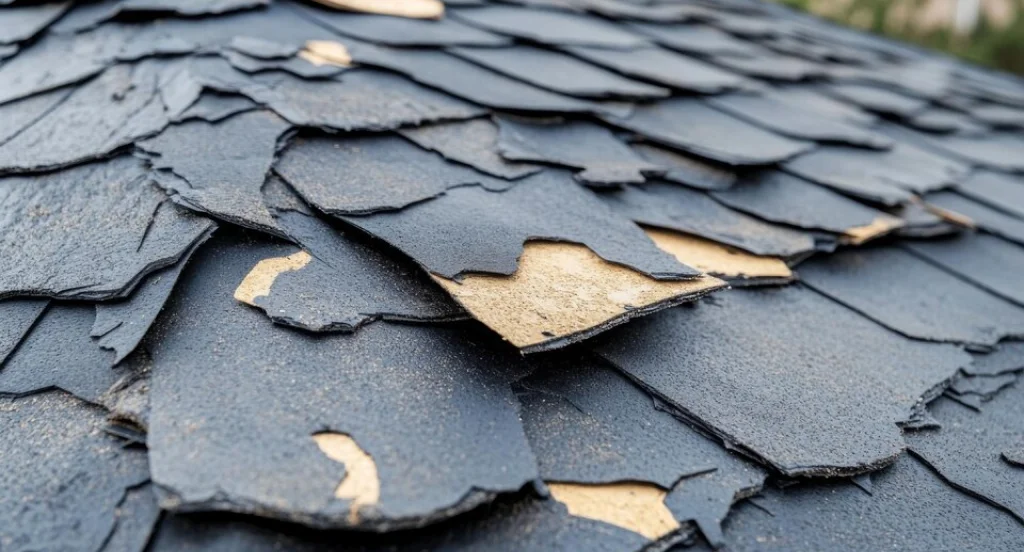
With a rough idea of where to look, go outside and find that part of the roof. Binoculars, or a window upstairs, get you closer without a ladder. Look for anything out of place, like a gap around a pipe, metal that’s lifted or rusty, or a shingle that’s missing or curled.
A clear view from below doesn’t rule a leak out, though. Some damage doesn’t show from the ground.
How the fix is chosen
The repair depends on what failed, so it’s worked out once the leak has been traced. It might be a new boot, new flashing or a few shingles replaced where they tore or blew off. If water has been getting in for a while, soft roof boards may need cutting out and replacing too, which roof decking replacement goes into.
If the roof keeps leaking, or the leaks move around an older roof, it may need more than another repair. Telling a repair job from a replacement takes you through the signs.
A wet patch in the attic or a ring on a ceiling gives us somewhere to start. Tell us where it is when you call (484) 553-0213, and we’ll work back from it to the opening and put the price of the repair in writing. That estimate is free. If the roof hasn’t shown you anything yet and you’d like it looked over all the same, that’s what our roof inspection is for.