


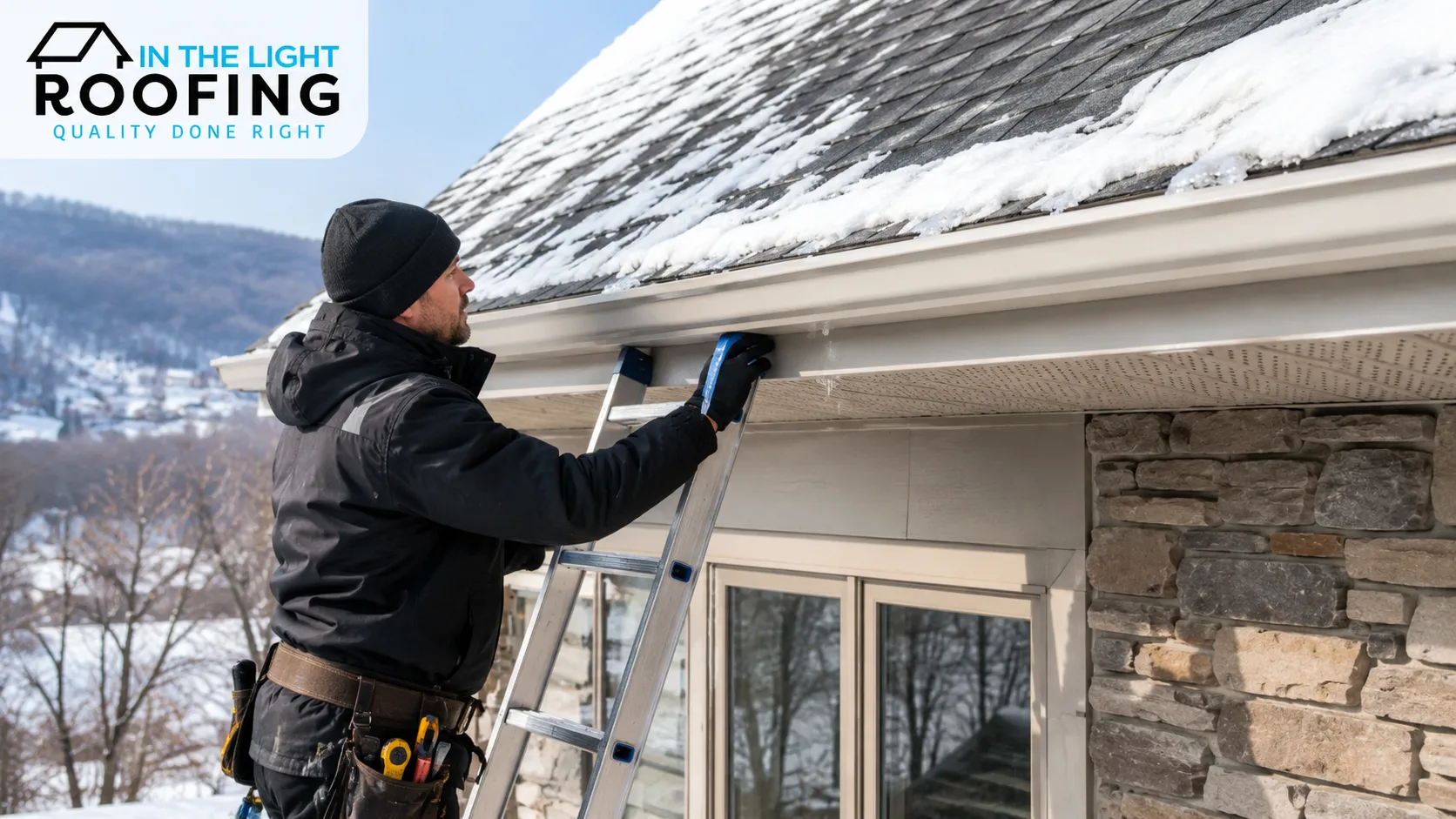
Ice dams are one of the few roof problems in the Lehigh Valley that build slowly enough to stop before they ever reach your ceiling. That is the case for Lehigh Valley roof ice dam prevention: the ridge of ice on your eaves does not appear overnight, and neither does the damage behind it.
At In The Light Roofing, we work on roofs across the Valley. Homeowners usually read ice at the roof edge as a shingle failure. More often the cause is above the ceiling, in the attic conditions that decide how warm the deck gets.
How Ice Dams Form on a Lehigh Valley Roof
Snow acts as insulation of its own. If the deck underneath is warmer than the outside air, the bottom layer melts, and the water runs down the slope to the eaves and gutter line, which hang past the heated part of the house and stay cold. There it refreezes, and our winters give it plenty of chances. An afternoon just above freezing followed by a night in the teens is an ordinary week here.
Repeat that and the ice builds into a ridge thick enough to block drainage. Water arriving behind it backs up under the shingle courses and finds the nail holes, the laps and the flashing. Shingles shed water running downhill. They were never built to hold back a pool.
What the Water Does Once It Is Behind the Shingles
The leak you can see is the last stage. Long before a ceiling stains, water behind a dam commonly causes:
- Saturated attic insulation that no longer insulates
- Mold growth in the trapped moisture above your bedrooms
- Soft, rotting roof decking under shingles that still look intact
- Peeling paint and stained ceilings on the top floor
- Warped fascia and gutters pulling away from the house
Most of it happens out of sight, which is why so much surfaces in spring.
What Your Own House Brings to the Problem
An ice dam is a roof problem with a floor plan behind it, and the housing stock here gives it several shapes. If your home is one of the brick twins or rowhomes in Old Allentown or the Old Fairgrounds district, you probably have a steep pitch, a shallow overhang at the eave and almost no room between the top of the wall and the deck. Where there is a soffit to vent at all, one batt pushed too far closes it. If the top floor was finished into bedrooms, the attic meant to stay cold is now heated space.
The older borough streets in Catasauqua, Coplay and Northampton run to the same pattern: attached houses on narrow lots, draining to a front eave and a rear eave with no side slopes to take the water. Once the front eave ices over, there is no second route off the roof. And on a tree lined block like the ones in Hamilton Park, the leaves nobody got to in November are still in that gutter in January, frozen into the base of the dam.
At the north end of the Valley, Slatington and Walnutport face each other across the Lehigh River at the foot of Blue Mountain. Snow tends to sit on a roof up there rather than blow off, so the weight deserves as much attention as the ice.
Newer, larger houses around Center Valley have the opposite issue. The roof is not old, but it is complicated: cross gables, dormers, a garage wing, often a cathedral ceiling with no real attic to ventilate. Every valley there is a channel where drifted snow collects. Out around Upper Macungie, wind scours some slopes bare and loads others deep, so one side of a house can ice while the other stays clear.
Why the Fix Is Above Your Ceiling
Insulation and ventilation do two different jobs, and ice dams punish the home where one is missing. Insulation slows the heat leaving your living space. Ventilation carries off the warm, moist air that gets through, so the deck stays near the outdoor temperature. Cold air should enter low at the soffits and leave high at the ridge. Block that path and you get a warm stripe of roof, then ice at the coldest point. It is also why chipping, salting and heat cables do not hold: none of them changes why the snow melted.
What You Can Do Before the First Hard Freeze
- Walk the attic with a flashlight, looking for frost, daylight or matted insulation
- Check that soffit vents are open and not buried under insulation
- Confirm bathroom and kitchen fans vent outside, not into the attic
- Clear gutters and downspouts so the first melt can drain
- Pull snow back from the roof edge with a roof rake, from the ground
None of that puts you on the roof. Please do not climb an iced roof yourself.
What We Look At During a Winter Roof Inspection
We start outside with a thorough examination, checking for damaged or missing shingles, signs of wear and any visible issues. Then we go inside, inspecting the attic for insulation, ventilation and water damage, and checking interior spaces for stains. You get a detailed report of our findings and recommendations, and where there is damage worth recording, we photograph it, so you have accurate information to share with your insurance provider.
When Prevention Turns Into Repair
Sometimes the ice has already won the season. Persistent leaks and water stains, cracked or curled shingles at the eave, a sagging roof deck, or granules in the gutters after the melt all point at the roof itself. Our roof repair services cover that work, from finding the source of a leak to replacing the shingles and flashing the water slipped past.
Final Thoughts: Fix the Cause, Not the Icicle
Icicles are the part that gets photographed. The cause is above your ceiling, in the balance between the heat your home loses and the air that should carry it away. If your eaves iced up last winter, they will ice up again unless something changes.
In The Light Roofing has worked on Lehigh Valley roofs since Bryson Berard opened the doors in 2017, and you are welcome to visit us in Allentown, PA to talk through your attic before the winter. If it becomes a project, we provide a no-cost estimate before you commit. Stop ice dams at the source, schedule your roof and attic inspection today.
Frequently Asked Questions
What actually causes ice dams on Lehigh Valley roofs?
Uneven roof temperature. Heat escaping into the attic melts snow up the slope, the water refreezes at the cold eaves, and the ice blocks drainage.
Do icicles always mean an ice dam?
Not always, but long or repeating icicles are worth checking, especially alongside attic frost or an upstairs ceiling stain.
Will adding insulation on its own solve it?
Rarely. They work as a pair, and adding depth while the soffit vents stay blocked leaves the attic warm.
Is it safe to remove an ice dam myself?
Stay off the roof. A roof rake used from the ground is the safe limit, and chipping or salting damages shingles and gutters.
Water is already coming through my ceiling. What now?
Contain the water, keep off the roof and call us. We will inspect the roof and attic, document what we find, and tell you which repairs are urgent.