


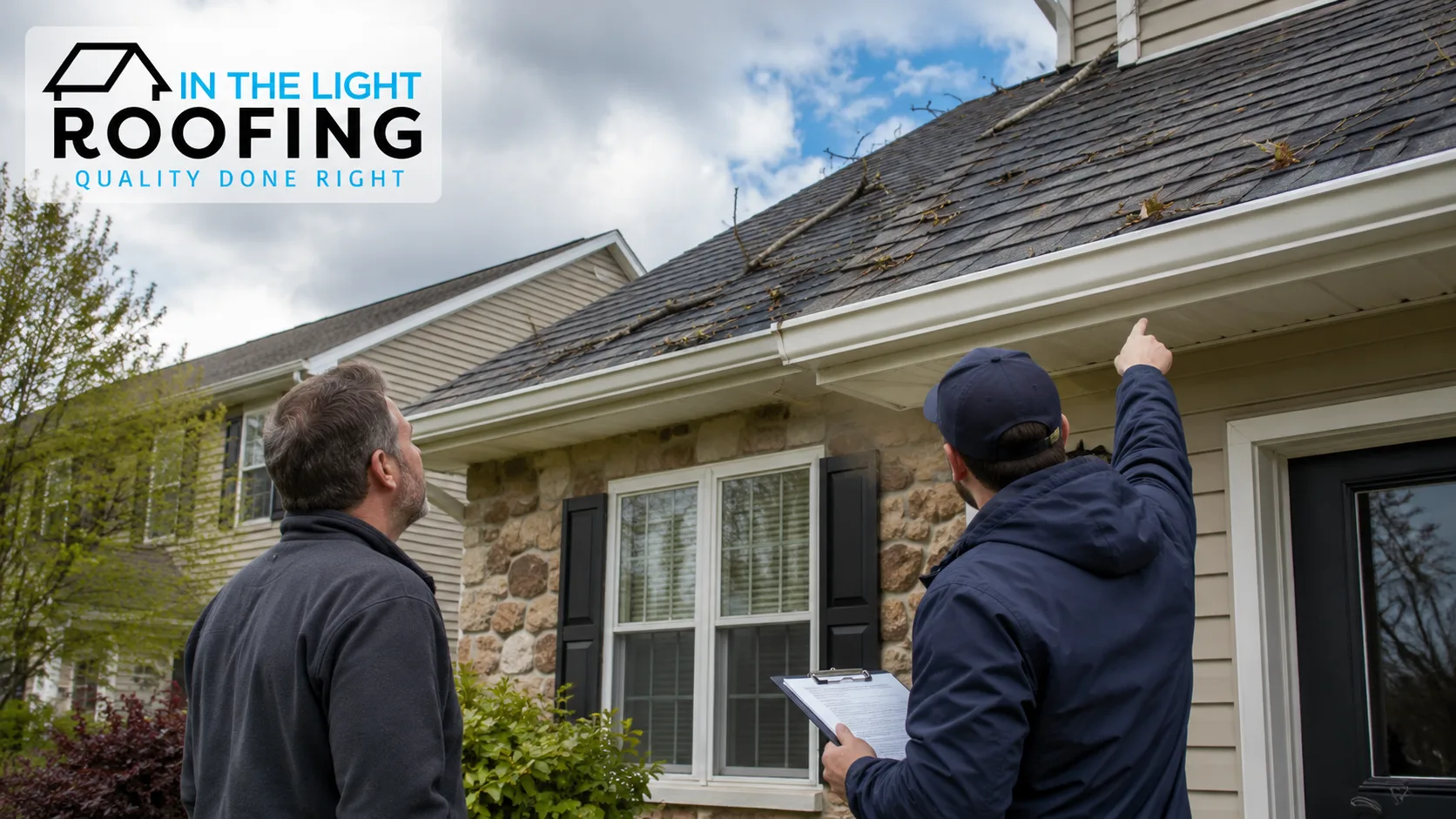
Storms move through the Lehigh Valley faster than most homeowners expect, and what they leave behind is rarely as obvious as a hole in the roof. A storm damage roof checklist gives you a calm order to work in once the wind drops, so you catch the quiet problems before they become stained ceilings and soaked insulation.
In The Light Roofing has been working on roofs here since 2017, from Slatington and Walnutport in the north down through Northampton, Catasauqua and Coplay to Center Valley. The damage that costs the most is rarely the damage that looked worst on the day. It is the damage nobody looked for.
What Lehigh Valley Storms Actually Do to a Roof
Three things tell you most of what you need to know: visible exterior damage such as missing or damaged shingles, interior water stains on ceilings and walls, and fallen debris or tree limbs left sitting on the roof.
Wind is the quiet one. It does not have to tear a shingle off; breaking the seal between courses is enough, because the next rain then has a path underneath. Hail bruises the surface, debris punctures it, and all three can leave a roof that looks normal from the sidewalk.
Start Where It Is Safe: Inside the House
Your first look should not be from a ladder. Interior evidence is easier to read and carries no risk.
Room by room
- Ceilings in every upstairs room, for fresh stains, rings or discoloration
- Where walls meet ceilings, and the corners along exterior walls
- Bubbling or peeling paint, which often shows up before a stain
- Any new draft, damp patch or musty smell
In the attic
- Daylight coming through the roof deck
- Insulation that feels wet, matted or compressed
- The underside of the decking around vents, chimneys and pipe boots
- Rust on nail shanks, which points to repeated moisture
Walk the Perimeter Before You Look Up
What lands around your house is evidence of what left your roof. Walk the full perimeter, including the side you never use.
- Collect shingle fragments and set them aside instead of throwing them out
- Check gutters and downspouts for dents, separation and granule buildup
- Look at the driveway, deck rails, siding and window screens for impact marks
Heavy granule loss points to deteriorating shingles on its own, and a storm accelerates it.
What to Check From the Ground, Looking Up
Stay off the roof. Use binoculars, or the zoom on your phone, from several angles.
- Missing, lifted, cracked or curled shingles, especially on the windward slope
- Ridge caps that look uneven or disturbed
- Flashing pulled away from a chimney, wall or vent
- Exposed underlayment showing as a lighter patch
Document Everything While It Is Fresh
Photograph what you find on the same day, from far enough back that the location is obvious and close enough that the damage is readable. Note the date of the storm and keep receipts for anything you buy to hold water back. That is what lets a roofer and an adjuster describe the same roof the same way.
Where Your House Sits Changes What You Check First
The Valley is not one roofing climate, and your own street narrows this list.
If your home is in one of the older river boroughs, Catasauqua, Coplay or Northampton, it probably sits close to its neighbors on a narrow lot, and there is a fair chance it is a twin or part of a row. Roofs like that run together across a shared wall, so the course that lifts on your side is the one that can let water into the house next door. Start at that shared line, then check the wall flashing where one roof meets another. Mature street trees compound it: they keep a slope damp, drop the same limbs into the same valleys, and fill the gutters that back water up under the shingles.
At the north end, Slatington and Walnutport face each other across the Lehigh River below Blue Mountain, and wind funnels along that corridor rather than arriving evenly. Work out which side of your roof faced the storm and start there, on the ridge caps, the rake edge and the courses just below the ridge, where uplift begins.
In Center Valley and the open ground around it, houses tend to be newer and larger, with little upwind to slow the wind down. Long slopes and long ridge lines give it more to push against, and a big roof can lose a run of ridge cap without one shingle landing in your yard. Read the whole ridge line, not just the stretch visible from the driveway.
When to Stop Checking and Call Us
Some findings end the checklist and start a phone call.
- Water is actively coming into the house
- You can see daylight through the roof deck
- A limb is resting on the roof
- A section of the roof looks sunken or uneven
- You have found damage and you intend to involve your insurer
If water is coming in right now, move what you can, put a container under it, and call us at (484) 553-0213. Do not climb up to tarp it yourself.
What Happens When We Inspect
Our approach to storm damage repair begins with an inspection of what the storm actually did, moves to the repairs that stop further damage, and finishes with a full restoration of the roof system. Our inspections cover the attic and interior as well as the exterior, because wind-driven rain travels along rafters well away from where it got in. You get a written report of what we found and what we recommend, and any work it recommends comes with a no-cost estimate.
Insurance: What We Do, and What We Will Not Promise
We specialize in storm damage repair and we assist with insurance claims: documenting the damage, taking on the paperwork and the back and forth with your carrier, and helping you understand your coverage.
What we will not do is tell you how your claim will be decided. That call belongs to your insurer. Our part is making sure your roof is described accurately.
Keep the List Where You Can Find It
Summer thunderstorms, fall wind and winter freeze and thaw test the same roof in different ways, so this checklist is worth running more than once a year. The expensive mistakes are ordinary: waiting to look, assuming an undamaged appearance means an undamaged roof, and throwing away the shingle pieces.
If you would rather talk it through in person, you are welcome to visit us in Allentown, PA and bring your photos with you. Found storm damage on your checklist? Book a roof inspection today.
Frequently Asked Questions
How soon after a storm should I check my roof?
As soon as it is safe to walk around outside, while the storm is still fresh in your mind.
Can I do this checklist myself?
The indoor, attic and ground-level parts, yes. Leave anything that requires getting onto the roof to a roofer.
My roof looks fine from the street. Do I still need an inspection?
Often, yes. Wind can break the seal between shingles without displacing them, and that is not visible from the ground.
What should I keep for an insurance claim?
Dated photos inside and out, the shingle pieces you found, the date of the storm, and receipts for anything you bought.